Category:
Book ReviewsChip War Review: Essential Reading for Our Geopolitical Moment
Prices can sometimes be lower on bigger marketplaces, but this link helps independent bookstores and local reading communities.
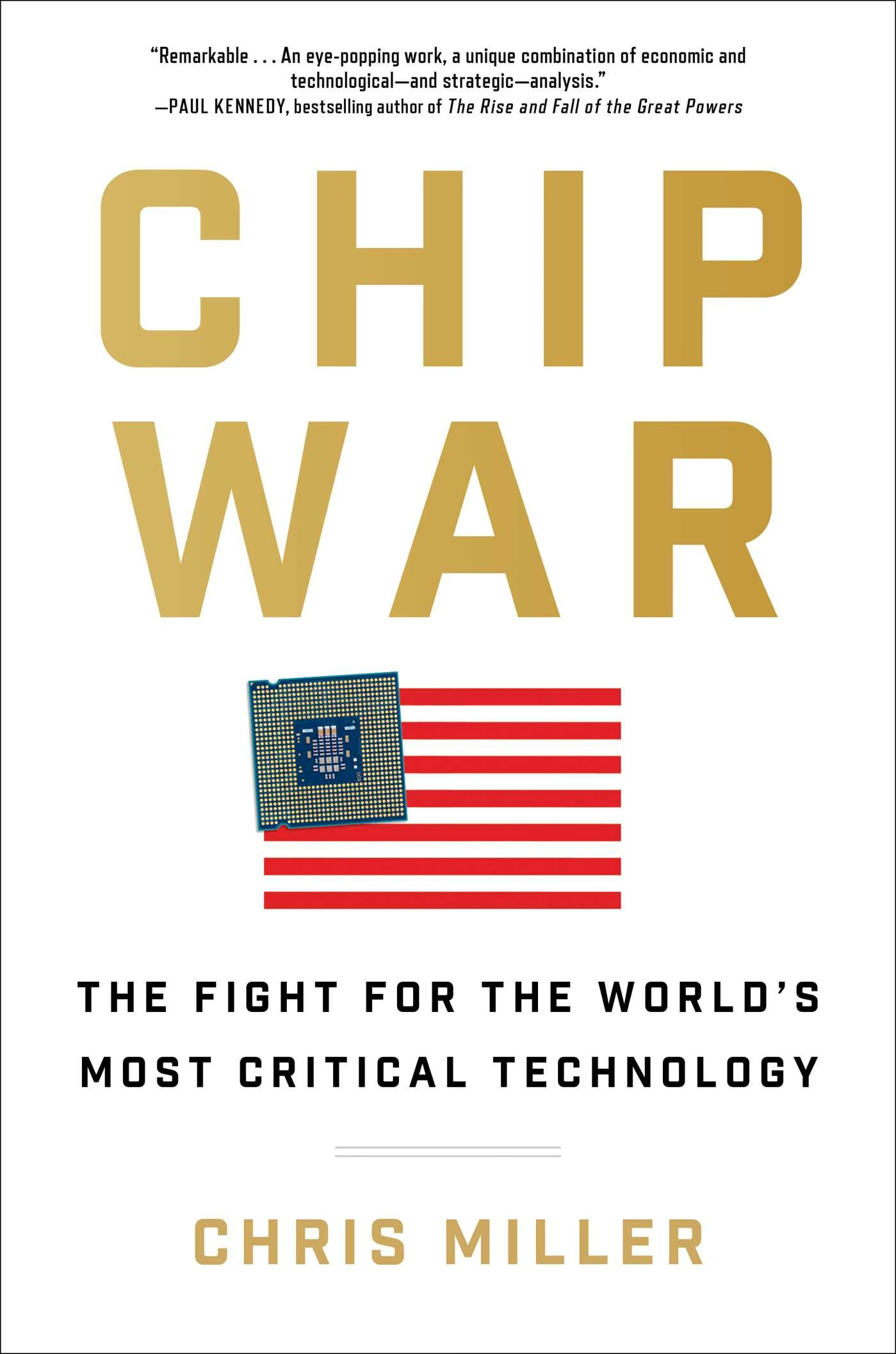
Chris Miller's Chip War: The Fight for the World's Most Critical Technology is a rare non-fiction achievement—it transforms what could have been a dry technical history into a gripping geopolitical thriller that explains why semiconductor dominance has become the defining conflict of our era. This is not a book about computers; it's a book about power, and Miller makes that distinction crystal clear from page one.
Quick Verdict
If you want to understand why Taiwan matters more than you think, why the US-China relationship hinges on manufacturing capacity rather than ideology, and why the global chip shortage wasn't just an inconvenience—Chip War is essential. Miller delivers rigorous economic history wrapped in genuine narrative tension. The question isn't whether this book is worth reading; it's whether you can afford not to.
What This Book Actually Does
Miller structures Chip War as an epic historical narrative spanning from the invention of the transistor through contemporary supply chain wars. The first half traces how American companies like Intel and Texas Instruments pioneered semiconductor manufacturing, then explores the stunning role of Morris Chang—passed over for CEO at Texas Instruments—who went on to found Taiwan's TSMC, the world's most critical chipmaker. This historical foundation isn't filler; it's essential context for understanding why Taiwan's geopolitical position has become non-negotiable.
The second half pivots to the present crisis: China's billion-dollar chip initiatives, the fragility of Western technological superiority, and the terrifying reality that over 40% of the world's advanced chip manufacturing happens on a single island that Beijing claims as its own. Miller argues compellingly that America's military dominance—which stems largely from superior computing power—now depends on supply chains that the US no longer controls.
The Historical Depth That Separates This from Journalism
What distinguishes Chip War from countless magazine articles about semiconductor shortages is Miller's willingness to go deep into the actual engineering and business history. He explains not just that ASML manufactures the world's most complex machines (EUV lithography systems), but why no other company can replicate this technology, and why this monopoly matters for geopolitical stability.
Readers with industry experience consistently note that Miller captures technical complexity without oversimplifying. The book explains different chip architectures (x86, ARM, RISC), various chip types (memory, logic, processors, GPUs), and the manufacturing processes that make advanced chips so difficult to produce. This isn't hand-waving; it's actual substance.
One particular revelation stands out: Bob Noyce, co-founder of Fairchild Semiconductor, also founded Intel. For readers new to chip history, these biographical threads reveal how concentrated the foundational innovation was, and how much of today's industry traces back to a handful of brilliant engineers.
Why This Matters Beyond Tech Circles
Miller's central argument is that semiconductors are the new oil—but with a crucial difference. Oil is abundant; advanced chip manufacturing capacity is scarce and concentrated. This asymmetry has military, economic, and political consequences that Miller traces with precision.
Consider the Ukraine war: Western "smart" weapons—Javelin missiles, Stinger anti-aircraft systems, Harpoon anti-ship missiles, and AI-enabled drones—work because they're saturated with advanced semiconductors. Ukrainian success against a larger military adversary is fundamentally a story about technological superiority embedded in silicon. Miller doesn't just observe this; he explains why this technological edge is now fragile.
The statistics alone are sobering: China spends more annually importing chips than importing oil. Over 90% of chip designs originate in the US or UK, yet manufacturing has migrated to Taiwan, Korea, Japan, and Singapore. This geographic dispersion of supply chains creates vulnerabilities that Miller explores with the gravity they deserve.
The Writing: Accessible Without Being Shallow
Miller writes with clarity and momentum. This is not a textbook; it reads like a well-researched thriller. He balances technical explanation with narrative momentum, moving between corporate boardrooms, geopolitical calculations, and engineering challenges without losing readers.
The pacing occasionally slows in the middle sections when Miller details various semiconductor architectures, but this slowdown serves a purpose—it demonstrates just how complex the technology is, and why so few entities can master it. This complexity is the book's actual subject.
Where the Book Falters
For all its strengths, Chip War has limitations worth acknowledging. The policy recommendations in the final chapters feel somewhat generic compared to the historical analysis. Miller advocates for US investment in domestic chip manufacturing and supply chain resilience, which is sensible but not particularly novel.
Additionally, the book's China analysis, while serious, occasionally veers toward the alarmist. Miller documents China's chip ambitions thoroughly, but some readers may feel the book understates the technical and capital barriers China faces in achieving advanced chip manufacturing. The gap between aspiration and execution in chip fabrication is vast, and Miller could have emphasized this more.
Finally, the book was published in 2022, so some material on recent developments (like the CHIPS Act's implementation or more recent geopolitical tensions) is necessarily absent. This isn't a flaw—it's simply the nature of publishing timelines—but readers seeking the very latest analysis may need supplementary sources.
Who Should Read This
Perfect for: Policymakers, technologists, investors, military strategists, and anyone trying to understand contemporary geopolitics. If you read about chip shortages or Taiwan tensions and felt confused, this book is your answer. If you work in tech but haven't studied the industry's history, Chip War will fill significant gaps. Readers interested in economic history, Cold War legacies, and how technology shapes power will find this deeply rewarding.
Will struggle with this: Readers seeking a quick take on semiconductors will find this too detailed. If you want a 50-page summary rather than a 400-page deep dive, look elsewhere. Those uncomfortable with geopolitical realism may find Miller's conclusions about American vulnerability unsettling.
Comparison Point
If you've read The Splendid and the Vile by Erik Larson or Thinking, Fast and Slow by Daniel Kahneman, you know the satisfaction of a book that combines rigorous research with compelling narrative. Chip War occupies similar territory—it's not as literary as Larson, nor as philosophically ambitious as Kahneman, but it matches their commitment to serious research presented engagingly. For geopolitical analysis, it's more accessible than The Second Cold War by Dmitri Trenin while maintaining comparable analytical rigor.
Is Chip War Worth Reading?
Yes, unambiguously. This is one of those books that shifts how you understand current events. Once you finish Chip War, every news story about Taiwan, every trade negotiation with China, every discussion of semiconductor manufacturing gains a new dimension. You'll understand why a small island's chip foundries matter more than most countries' entire economies.
Chris Miller's Chip War succeeds because it refuses to separate technology from history, economics from geopolitics, or corporate strategy from national security. In doing so, it illuminates one of the defining conflicts of the 21st century through the lens of something most of us never think about.
Final Score
8.5/10 — A meticulously researched, compulsively readable history that makes a convincing case for why semiconductor dominance will define the next era of global power.