Category:
Book ReviewsCatch the Devil Review: A Devastating Indictment
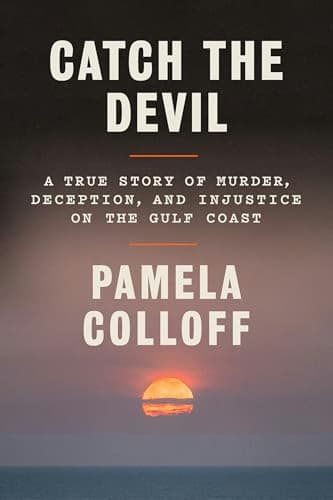
Prices can sometimes be lower on bigger marketplaces, but this link helps independent bookstores and local reading communities.
Quick Verdict
Catch the Devil: A True Story of Murder, Deception, and Injustice on the Gulf Coast by Pamela Colloff is a meticulously researched true crime narrative that exposes a rotting core of the American criminal justice system. This is not entertainment—it's an urgent document of how institutional negligence, prosecutorial ambition, and a remorseless sociopath conspired to imprison an innocent man for four decades. If you want to understand why jailhouse informants remain a catastrophic threat to justice, this book is essential reading.
What This Book Is Actually About
Colloff's debut tackles the staggering true story of Paul Skalnik, a serial con artist and pathological liar who weaponized the Florida court system with devastating precision. Over three decades, Skalnik reinvented himself relentlessly—fighter pilot, oilman, attorney, undercover agent—accumulating nine marriages, countless fraud victims, and a trail of exploited girls barely into adolescence. But his most toxic con wasn't romantic: it was judicial.
Locked in Pinellas County Jail awaiting trial for his own crimes, Skalnik discovered an even more profitable racket. He claimed other inmates had confessed crimes to him, then sold these fabricated stories to prosecutors hungry for quick convictions. The system rewarded him with freedom. Between 1985 and the early 2000s, Skalnik's testimony helped imprison dozens of men—three of whom landed on death row.
The centerpiece of Colloff's investigation is Jim Dailey, a down-on-his-luck Vietnam veteran arrested for the 1985 murder of a fourteen-year-old girl. No forensic evidence connected Dailey to the crime. No motive existed. But Skalnik's account of a jailhouse "confession" proved sufficient. Dailey was convicted and sentenced to death, where he remained for over forty years—even after another man confessed to the actual killing and Skalnik refused to recant his lies.
The Writing: Controlled Fury Disguised as Journalism
Colloff, an award-winning New York Times Magazine writer, approaches this material with surgical precision rather than sensationalism. Her prose is deliberately restrained, which makes the horror more acute. She doesn't need dramatic flourishes when the facts are this damning.
The narrative structure moves between Skalnik's criminal history and the specific case of Jim Dailey, allowing readers to understand both the pattern and the particular injustice. Colloff includes interviews with Skalnik himself—his refusal to recant despite overwhelming evidence of his fabrications becomes its own character study in sociopathy.
The pacing works because Colloff trusts her material. She builds context methodically: how jailhouse informant testimony became normalized in Florida courts, how prosecutors developed relationships with serial liars, how judges and appeals courts became invested in maintaining convictions rather than pursuing truth. This isn't a page-turner in the thriller sense; it's a page-turner in the sense that each revelation feels inevitable yet shocking.
What Works: The System Indictment
The central achievement of Catch the Devil review reveals is how thoroughly Colloff documents institutional complicity. This isn't just a story about one bad actor. It's an anatomy of how prosecutorial incentives, judicial conservatism, and bureaucratic inertia created an environment where a man could fabricate testimony for three decades and remain untouchable.
Colloff demonstrates that prosecutors in Pinellas County knew—or should have known—that Skalnik was unreliable. Yet they continued using him because he delivered convictions. The system protected him because the system benefited from him. This is the most damning aspect of the book: the machinery didn't malfunction. It operated exactly as designed.
The research is formidable. Colloff accessed court records, trial transcripts, prison correspondence, and conducted extensive interviews. She doesn't present speculation as fact; she distinguishes between what's documented and what's inferred. This rigor makes her conclusions more devastating because they're earned.
For readers familiar with Michelle Alexander's The New Jim Crow or Bryan Stevenson's Just Mercy, Colloff's book provides a granular, case-specific illustration of systemic dysfunction. She moves beyond abstraction to show exactly how innocent people become trapped in the machinery.
What Doesn't Quite Land
The book's main limitation is also its greatest strength: Colloff maintains journalistic distance when readers might crave more emotional access. We understand Jim Dailey's suffering intellectually, but Colloff's restrained approach sometimes keeps us at arm's length from the full weight of his experience.
Additionally, while the Skalnik portrait is comprehensive, the book might have benefited from deeper psychological analysis of his pathology. Colloff documents his behavior exhaustively but doesn't fully explore the question of how someone becomes this broken. This isn't a major flaw—the focus on systemic failure rather than individual psychology is actually the right choice—but readers seeking psychological depth may feel something missing.
The resolution, while factually satisfying, carries the frustration of an unresolved ending. Dailey remains imprisoned as of the book's publication, which is the point Colloff wants to make, but it leaves readers in a state of justified rage rather than catharsis. Some will find this powerful; others may find it unsatisfying as narrative closure.
Who Should Read This (and Who Shouldn't)
Perfect for: True crime readers who want substance over sensationalism. Criminal justice reform advocates. Anyone interested in how institutions fail. Readers of Stevenson, Alexander, or John Grisham's non-fiction work. Law students and legal professionals. Anyone who believes the American justice system is fundamentally sound—this will challenge that assumption.
Skip if: You want entertainment rather than documentation. You're seeking a traditional narrative arc with resolution and redemption. You believe jailhouse informants are generally reliable. You prefer true crime that focuses on the criminal's psychology rather than systemic failure.
The Larger Context: Why This Matters Now
Jailhouse informant testimony remains one of the most unreliable forms of evidence in American courts, yet it continues to be used extensively. The Innocence Project has documented that informant testimony is present in roughly 15% of exonerations, despite representing a much smaller percentage of actual testimony. Colloff's book arrives at a moment when criminal justice reform is gaining momentum, making it timely and necessary.
Pamela Colloff's Catch the Devil also arrives amid ongoing debates about wrongful convictions on death row. The book demonstrates that even when exonerating evidence emerges, courts resist overturning convictions. This isn't a failure of the system to work; it's the system working as designed—prioritizing finality over justice.
Final Verdict
8.5/10 — A meticulously researched, morally urgent true crime narrative that indicts not just one criminal but an entire system's willingness to prioritize convictions over truth. Essential reading for anyone who wants to understand how the American justice system actually functions.
Is Catch the Devil worth reading? Absolutely—but not because it's thrilling. It's worth reading because it's true, thoroughly documented, and deeply important. Colloff has written a book that will haunt you not with mystery but with the clarity of injustice.