Category:
Book ReviewsBlizzard of Lies Review: Ambitious But Uneven True Crime
Prices can sometimes be lower on bigger marketplaces, but this link helps independent bookstores and local reading communities.
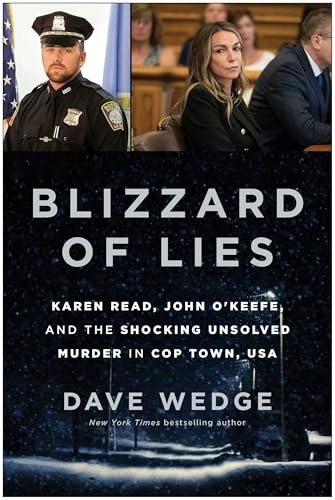
Dave Wedge's Blizzard of Lies: Karen Read, John O'Keefe, and the Shocking Unsolved Murder in Cop Town, USA attempts to be the definitive account of one of America's most polarizing recent true crime cases. The book follows the death of Boston police officer John O'Keefe in January 2022 and the subsequent accusation, trial, and 2025 acquittal of his girlfriend Karen Read. Yet despite tackling a case that has captivated the nation and raised serious questions about police corruption and institutional accountability, Wedge's effort feels frustratingly incomplete—caught between wanting to be comprehensive and struggling to deliver genuine investigative depth.
The Case That Divided America
For those unfamiliar, the O'Keefe case represents a rare moment when institutional cracks in American law enforcement became impossible to ignore. What initially appeared to be a straightforward hit-and-run death spiraled into a scandal involving alleged police cover-ups, destroyed evidence, and potential misconduct that has called other murder cases into question. The case generated enormous media attention and public passion, with online communities, podcasts, and independent journalists covering developments obsessively.
This is the environment into which Wedge's book arrives. The case had already been exhaustively documented, debated, and dissected before publication. That makes the author's task both easier and harder: easier because readers already care deeply, harder because they demand something genuinely new.
What Wedge Gets Right
The book's strongest asset is its access. Wedge conducted interviews with people across the entire spectrum of the case—law enforcement, Read's legal team, the O'Keefe family, and others. This gives Blizzard of Lies an insider dimension that casual media coverage couldn't provide. His sections on John O'Keefe's policing career and his personal history before meeting Karen Read offer valuable context that humanizes the victim beyond headlines.
Wedge also demonstrates genuine journalistic instinct in connecting the dots between institutional failures. His exploration of how evidence was handled, how investigations proceeded, and how the trial revealed troubling patterns of potential misconduct shows the kind of critical thinking true crime readers deserve.
The Structural Problem
Here's where the Blizzard of Lies review becomes complicated: the book's organizational choices actively work against reader engagement. Early chapters devoted to professional backgrounds, career histories, and biographical scaffolding feel like necessary exposition that nonetheless drains momentum. For readers who lived through the case in real-time, these sections feel like padding. For newcomers, they're presented so gradually that the actual case feels distant.
The pacing issue is compounded by what feels like uneven editorial judgment. Wedge spends considerable energy addressing criticism from online content creators and podcasters who covered the trial—arguably a distraction from the case itself. While acknowledging the role of independent media in keeping cases alive is fair, devoting narrative real estate to defending against bloggers feels defensive rather than authoritative.
The Bias Problem
Multiple readers have noted—and this Blizzard of Lies review must address it directly—a perceptible bias against Karen Read throughout the narrative. Wedge promises "a definitive narrative" but delivers something closer to a sympathetic account of institutional failure that still frames Read as a central problem rather than a woman caught in a system that failed her.
This is particularly frustrating because the book's most compelling material involves the very institutional corruption that should be the central focus. The sallyport issues, the destroyed phones, the questionable investigative decisions—these deserve deeper excavation. Instead, they receive passing mentions before the narrative moves on. It's like watching a documentary that keeps cutting away from the most important evidence.
Audiobook Narration Issues
For those consuming the audiobook version, there's an additional problem worth noting. The narrator's portrayal of Karen Read's voice reportedly feels inaccurate and problematic to those familiar with the case. This is a significant flaw in audio production—narrator choices shape how readers experience characters, and mishandling a real person's voice can undermine credibility.
Who Should Read This
Perfect for: People new to the case seeking a structured overview. Readers interested in how institutional corruption manifests in law enforcement. Those who want to understand the O'Keefe family's perspective and the emotional toll on those involved.
Skip it if: You've closely followed the case in real-time—you'll find little new information. You want deep investigative journalism that fully explores the corruption angles. You're looking for a narrative that centers John O'Keefe rather than the controversy surrounding his death.
The Comparison Point
Think of Blizzard of Lies as occupying the space between I'll Be Gone in the Dark by Michelle McNamara and a true crime podcast. McNamara's book succeeds because it uses investigative reporting as a vehicle for genuine discovery. Wedge has access and documents facts, but he doesn't quite achieve that same revelatory quality. The case has already been revealed—often by independent media—and Wedge's book sometimes feels like it's catching up rather than leading.
Verdict
Dave Wedge's Blizzard of Lies is a competent but ultimately disappointing attempt to provide the definitive account of a case that demands exactly that. The book contains valuable material and genuine reporting, but it's undermined by structural choices that prioritize comprehensiveness over compelling narrative, and by a subtle bias that contradicts its promise of objectivity. It works as an introduction for newcomers but offers little to those who've followed the case closely. The tragedy here isn't just O'Keefe's unsolved death—it's that a book with this much access and institutional insight doesn't dig deeper into the corruption that makes the case genuinely important.
For readers asking "Is Blizzard of Lies worth reading?"—the answer depends entirely on your familiarity with the case. If you're new to it, yes. If you've been following closely, you might find better detail in the podcast coverage that Wedge himself seems to resent. That's not quite the ringing endorsement this case deserves from its definitive account.