Category:
Book ReviewsBlack Holes Review: Brilliant But Brutally Demanding
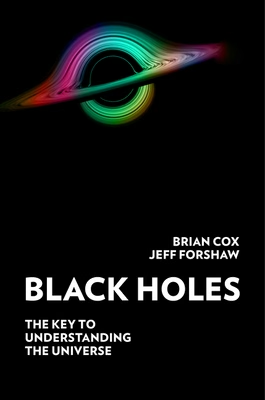
Prices can sometimes be lower on bigger marketplaces, but this link helps independent bookstores and local reading communities.
Brian Cox and Jeff Forshaw's Black Holes: The Key to Understanding the Universe is a fascinating paradox—a book that manages to be simultaneously accessible and impenetrable, thrilling and exhausting. This definitive narrative on black holes succeeds brilliantly at explaining why these cosmic objects matter to our understanding of reality, but it demands intellectual stamina that will challenge even readers with solid science backgrounds.
What This Book Actually Is
Black Holes: The Key to Understanding the Universe isn't a coffee-table book about space. It's a rigorous exploration of how black holes confirm Einstein's theory of general relativity and what they reveal about the fundamental nature of our universe. Cox and Forshaw tackle spacetime geometry, event horizons, Hawking radiation, quantum entanglement, and Penrose diagrams—the heavy machinery of modern physics.
The book opens with a concrete anchor: Sagittarius A*, the supermassive black hole at the heart of the Milky Way, a distortion 4 million times more massive than our Sun. From there, the authors build outward, explaining how black holes form, what happens at their event horizons, and why they're essential to understanding everything from the Big Bang to the ultimate fate of the universe.
The Writing: Accessible Ambition Meets Hard Physics
Cox has built his reputation on making complicated science engaging—from his BBC podcast The Infinite Monkey Cage to his bestselling collaborations with Forshaw. That skill is genuinely on display here. The authors explain concepts with clarity and enthusiasm, and they're clearly excited about their subject matter. You can feel their passion for black holes radiating from every page.
But here's the tension: accessibility has limits when your subject is genuinely complex. The diagrams depicting spacetime and Penrose diagrams are mind-bending by necessity, not poor design. Some readers will find pages that look like college physics textbooks from decades past—equations, abstract geometry, concepts that don't yield to casual reading. This isn't a flaw; it's honest. The authors aren't dumbing down the material; they're explaining it as clearly as the material allows.
What Works Brilliantly
The book excels at contextualizing why black holes matter beyond mere curiosity. Cox and Forshaw demonstrate how black holes test the limits of our theories and reveal where quantum mechanics and general relativity collide. They explain Hawking radiation in terms that make the concept graspable, even if the full mathematics remains forbidding.
The structure is logical and builds methodically. Each chapter adds layers of understanding rather than jumping randomly between topics. Readers who stick with it report genuine "aha" moments—understanding spacetime curvature, grasping why nothing escapes an event horizon, or comprehending why black holes might actually be portals to understanding quantum gravity.
For readers with even a modest science background, the book delivers substantial intellectual satisfaction. It's the rare popular science work that doesn't condescend to its audience while still remaining (mostly) comprehensible to non-specialists.
Where It Stumbles
The honest assessment: this book will lose readers. Some will abandon it around the 50% mark, finding the density overwhelming despite genuine interest in the subject. Others will find themselves highlighting passages to revisit later, treating sections as reference material rather than narrative prose.
The challenge isn't poor writing—it's that black holes are complicated. No amount of authorial skill can make advanced physics feel effortless. Readers expecting something like Brian Greene's The Elegant Universe (which covers broader theoretical physics with more narrative breathing room) may feel frustrated. This book prioritizes accuracy and depth over comfort.
The diagrams, while necessary, can feel intimidating. Some readers report pages that triggered flashbacks to difficult college courses. The book doesn't hold your hand through every mathematical concept, assuming readers will tolerate some productive struggle.
Who Should Actually Read This
Perfect for: Physics enthusiasts with some background knowledge, curious readers willing to reread dense passages, people fascinated by space who don't mind intellectual challenge, anyone wanting a definitive popular-science treatment of black holes.
Reconsider if: You want a purely entertaining space book, you're looking for quick, easy reads, you have minimal science background and want to avoid frustration, you prefer narrative-driven popular science over conceptual rigor.
The middle ground: Readers with genuine curiosity but no physics background can absolutely engage with this book—but approach it as a slow read, not something to consume in a weekend. Have a notebook nearby. Look up concepts that confuse you. The reward for that effort is real understanding rather than superficial familiarity.
The Real Verdict
Is Black Holes: The Key to Understanding the Universe worth reading? Yes, if you're willing to meet it halfway. This isn't a book that works for everyone, and that's not a weakness—it's honesty. Cox and Forshaw refuse to oversimplify their subject, and that integrity makes the book valuable precisely because it doesn't pretend black holes are simple.
Compared to similar popular physics books, this ranks closer to Brian Greene's technical works than to Carl Sagan's more poetic explorations. It's more demanding than Mary Roach's Packing for Mars but more accessible than academic textbooks. The sweet spot is readers who loved Cosmos but wanted more substance, or science enthusiasts ready to be challenged.
The book's 4.07/5 rating across nearly 3,000 reviews tells the story: many readers found it brilliant despite (or because of) its difficulty. Others bounced off the density. Both responses are valid. The key question isn't whether the book is good—it clearly is—but whether you're the right reader for this particular book.
Final Verdict
8/10 — A rigorous, well-written exploration of black holes that refuses to sacrifice accuracy for easy accessibility, rewarding committed readers with genuine understanding.