Category:
Book ReviewsArt of the Chicken Review: A Masterpiece Beyond Recipes
Prices can sometimes be lower on bigger marketplaces, but this link helps independent bookstores and local reading communities.
Jacques Pépin's Art of the Chicken: A Master Chef's Paintings, Stories, and Recipes of the Humble Bird is a deceptively simple book that refuses to be categorized. It's not quite a cookbook, not quite a memoir, and definitely not a traditional art book—yet it succeeds brilliantly at being all three simultaneously. This is the rare hybrid that works because Pépin understands something fundamental: the chicken isn't just an ingredient, it's a lens through which to examine a life well-lived.
The Unexpected Strength: It's Not Really a Cookbook
If you're searching for a Art of the Chicken review expecting precise measurements and step-by-step instructions, you'll be disappointed—and that's precisely where this book's genius lies. Pépin deliberately abandons the cookbook format in favor of something more intimate: recipes as conversation starters. Each dish arrives with context—where he learned it, who taught him, what it meant during a particular chapter of his extraordinary career.
This approach mirrors the philosophy of traditional French country cooking, where recipes were never written down but passed through demonstration and repetition. Pépin's mother didn't hand him a card with ingredient ratios; she showed him how to feel the chicken's readiness, how to judge doneness by instinct. By refusing to over-specify, he honors that tradition while inviting readers into his actual kitchen rather than a sanitized test version.
The fifty-plus recipes function more as inspiration than instruction—a blueprint for understanding Pépin's approach rather than a guarantee of identical results. For experienced cooks, this is liberating. For novices, it's occasionally frustrating, though that tension is part of the book's appeal.
The Paintings: Where Art Becomes Memoir
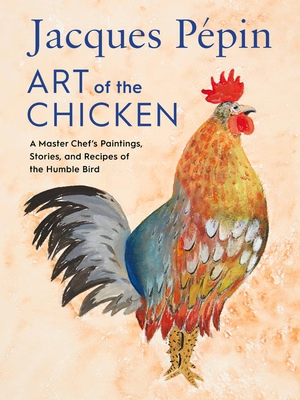
The dozens of chicken paintings scattered throughout aren't decorative flourishes; they're the emotional core of the entire project. Pépin's artwork ranges from whimsical to surprisingly tender, capturing birds mid-scratch, mid-flight, and mid-contemplation with the same attention he'd give to painting a human subject. What's remarkable is his refusal to make the chicken precious or overly cute. These are working birds, rendered with the respect of someone who understood their practical value from childhood.
The paintings do something photography rarely achieves: they convey personality and movement while maintaining a certain timelessness. Looking at them, you understand why Pépin has spent decades painting the same subject. There's infinite variation within apparent simplicity—the perfect visual metaphor for what he's attempting with the recipes and stories.
The Memoir Hidden Inside
This is where Art of the Chicken by Jacques Pépin reveals its true ambition. The book traces his journey from a rural French childhood during World War II through his apprenticeship in the rigid hierarchies of Parisian kitchens, his controversial decision to turn down the White House chef position under Kennedy to work at Howard Johnson's, his television partnerships with Julia Child, and his life with his wife Gloria. Yet unlike a traditional autobiography, these stories never feel self-aggrandizing.
Pépin's willingness to discuss the less glamorous chapters—his shyness as a young apprentice, his family's economic struggles, the reasons behind career choices others considered foolish—creates genuine intimacy. When he discusses learning to slaughter chickens from his mother, there's no romanticization, just honest acknowledgment of what survival cooking required. This honesty is rare in chef memoirs, which often drift toward hagiography.
What Truly Works
The emotional architecture is flawless. Each section builds naturally from the previous one, with recipes and paintings functioning as emotional punctuation. The writing feels genuinely conversational—you can almost hear Pépin's voice, with its slight French inflections and self-deprecating humor, guiding you through his life.
The book also succeeds because it respects the reader's intelligence. Pépin doesn't explain why the chicken matters or why his life is worth examining. He simply shares it, trusting that the cumulative effect will resonate. This restraint is increasingly rare in food writing, where authors often over-explain their emotional connections to ingredients.
The production quality deserves mention. The book is genuinely beautiful to hold and look at—the kind of object you'll return to repeatedly, not just for the content but for the experience of engaging with it.
The Legitimate Limitations
For readers seeking a functional cookbook, this book will frustrate. The recipes lack precise measurements, timing details, and yield information. You'll need existing cooking knowledge to successfully execute most dishes. If you're looking for Julia Child's Mastering the Art of French Cooking level of instruction, you won't find it here.
Some readers also noted wishing for food photography alongside the paintings. While the artistic choice to exclude finished-dish photos maintains the book's aesthetic coherence, it does create a gap between imagination and execution. You're essentially cooking from memory and intuition rather than visual reference.
The book also doesn't delve deeply into chicken nutrition, sourcing, or the industrial farming practices that have transformed how we raise and consume poultry. For readers interested in the ethical dimensions of chicken consumption, this book offers nostalgic celebration rather than critical examination.
Who Should Read This
Perfect for: Experienced home cooks who view recipes as starting points rather than gospel; memoir enthusiasts who appreciate unconventional structure; anyone who has watched Pépin's television work and wants deeper insight into his philosophy; gift-givers seeking something genuinely unique; people who appreciate food writing as literature rather than mere instruction.
Will likely disappoint: Absolute beginners seeking clear instructions; readers expecting comprehensive nutritional information; those wanting traditional cookbook organization; people who dislike memoir elements mixed with recipes.
Comparison Point
If you've read Anthony Bourdain's Kitchen Confidential, you'll recognize similar DNA—a chef using personal narrative to explore a life in food. But where Bourdain was confrontational and cynical, Pépin is gracious and reflective. This book is closer in spirit to Ruth Reichl's Garlic and Sapphires, where memoir and food intertwine as equals rather than one serving the other.
The Verdict
Art of the Chicken is absolutely worth reading, though not for the reasons you might initially expect. It's a meditation on a life dedicated to craft, told through an ingredient that never stopped fascinating its author. The paintings are stunning, the stories are genuine, and the recipes—while demanding—carry the weight of lived experience. Yes, it's unconventional. Yes, it requires a certain reader to fully appreciate. But for that reader, it's genuinely special.
This is a book that respects your time and your intelligence. It doesn't overstay its welcome, doesn't explain itself to death, and doesn't pretend to be something it's not. In an era of bloated cookbooks and ghostwritten memoirs, that restraint feels revolutionary.