Category:
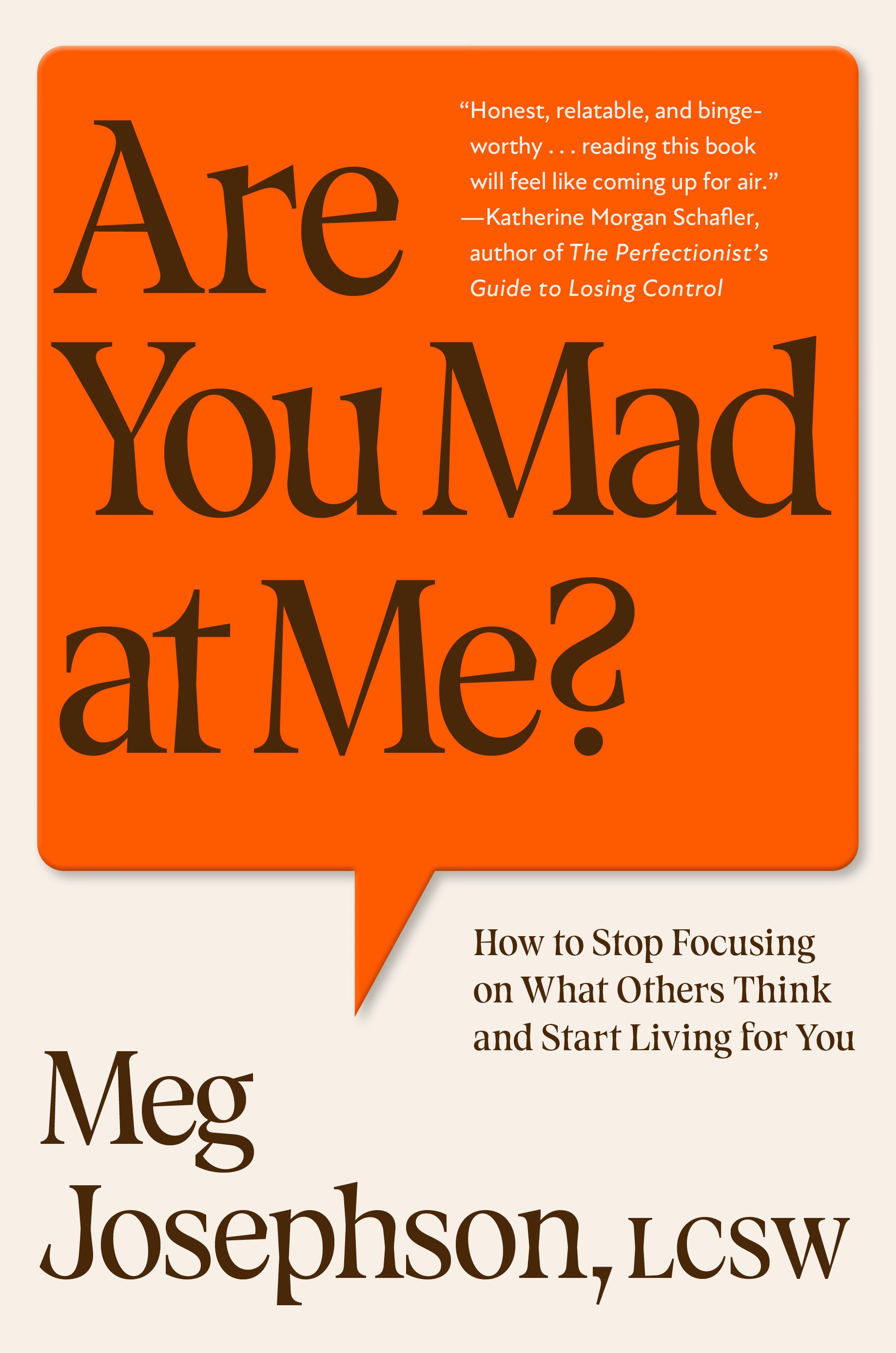
Self-HelpAre You Mad at Me? Review: Finally, Self-Help That Actually Works
Prices can sometimes be lower on bigger marketplaces, but this link helps independent bookstores and local reading communities.
Quick Verdict
Are You Mad at Me? by Meg Josephson is a rare self-help book that delivers on its promise. Rather than offering surface-level advice to "just stop people-pleasing," Josephson provides a groundbreaking framework for understanding why you sabotage your own needs in the first place. This is the kind of psychological work that sticks with you—and actually changes how you show up in relationships.
What This Book Actually Is (And Isn't)
Let's be clear: this isn't another productivity hack or mindfulness manual. Meg Josephson's Are You Mad at Me? review reveals something far more valuable—a clinical yet deeply human exploration of fawning, the lesser-known trauma response that keeps millions trapped in chronic people-pleasing patterns.
Josephson, a licensed psychotherapist and social media educator, argues that people-pleasing isn't a personality quirk or a sign of kindness. It's a survival mechanism. When you were younger, you learned that becoming appealing, agreeable, and helpful to perceived threats kept you safe. That instinct made sense then. It's destroying your relationships now.
The book weaves Josephson's own story with client narratives and practical exercises to show readers how fawning operates across five distinct roles: the peacekeeper, the performer, the caretaker, the lone wolf, and the perfectionist. Understanding which roles you play is the first step toward recognizing when you're abandoning yourself.
The Trauma Response Nobody Talks About
Most people know about fight, flight, and freeze responses to threat. Josephson introduces the fourth: the fawn response. This is where the real insight lives.
When faced with danger, your nervous system doesn't just activate aggression, escape, or shutdown. It also activates appeasement. You become more likable, more helpful, more agreeable—all to satisfy the perceived threat and feel safe. The problem? Society rewards this behavior. Your boss appreciates your overtime. Your family appreciates your self-sacrifice. Your friends appreciate your emotional labor. Nobody tells you it's costing you your authentic self.
This is why fawning remains the most common yet least discussed trauma response. Unlike aggression or withdrawal, appeasement looks like virtue. Josephson's Are You Mad at Me? review of this cultural blind spot is one of the book's greatest strengths—she names something readers have felt their entire lives but never had language for.
Writing Style: Clinical Meets Conversational
One of the biggest complaints about self-help books is that they either sound like textbooks or self-parody. Josephson navigates this perfectly.
Her prose is clear and direct without being clinical. She explains neurobiology and attachment theory in ways that make sense to actual humans. The client stories feel authentic—they're detailed enough to resonate but not so voyeuristic that they feel exploitative. And crucially, she doesn't pretend to have all the answers. She shows her own work, including her struggles with these patterns.
The book is structured so you can read it cover-to-cover or jump to sections that call to you. The exercises are practical and non-performative. There's no "manifest your best self" energy here—just honest psychological work.
What Actually Works Here
The framework for distinguishing between necessary and unnecessary people-pleasing is genuinely useful. Josephson acknowledges that sometimes strategic niceness is appropriate—with your chaotic boss, in professional settings, with people who have demonstrated they're unsafe. The goal isn't to become a boundary-obsessed asshole. It's to recognize when you're performing for people who deserve your authenticity.
The concept of "leaning back" in relationships is transformative. Instead of over-functioning, over-explaining, over-apologizing, you practice restraint. You let others sit with their own discomfort. You stop rescuing people from natural consequences. For chronic people-pleasers, this single reframe is worth the price of the book.
Josephson's discussion of how people-pleasing shows up in your body is also exceptional. Readers consistently report that her insight—"your body isn't a coffin for your pain and unprocessed emotions, it's a vessel for your life"—fundamentally shifts how they relate to their own physical experience. She connects the dots between emotional suppression and physical tension in ways that feel immediately applicable.
The emphasis on compassion versus niceness is critical. True compassion, Josephson argues, requires boundaries. Compassion without boundaries becomes self-betrayal. This distinction liberates readers from the guilt that usually accompanies boundary-setting.
Where the Book Stumbles
If you're looking for a quick fix, you'll be disappointed. Josephson doesn't promise that reading this book will cure your fawning overnight. Some readers interpret this honesty as the book not going far enough. It does—just not in the way they expected.
The exercises, while excellent, require genuine self-reflection. If you're the type who reads self-help books without actually doing the work, you'll get less from this than someone willing to sit with discomfort. That's not a flaw in the book; it's a feature.
Some readers also note that the book is most powerful for those with relational trauma or anxious attachment styles. If your people-pleasing stems from a different source (cultural conditioning alone, for instance), certain sections may feel less personally relevant. This is a minor limitation in an otherwise comprehensive work.
Who Should Read This (And Who Shouldn't)
Perfect for you if:
- You constantly worry about what people think of you
- You over-apologize, over-explain, or over-function in relationships
- You feel resentful after agreeing to things you didn't want to do
- You avoid conflict at all costs, even when healthy boundaries are necessary
- You identify as anxious, perfectionist, or an overachiever
- You've read other self-help books and found them too surface-level
Skip it if:
- You're looking for quick fixes or motivational pep talks
- You're not willing to do genuine psychological work
- You have no interest in trauma-informed approaches to personal development
- You prefer narrative memoir over framework-based self-help
How It Compares
If you've read Brené Brown's work on vulnerability, Josephson goes deeper into the neurobiology of why vulnerability feels unsafe. If you've engaged with Pete Walker's material on trauma responses, this book makes that framework accessible to a mainstream audience. Where Harriet Lerner's Why Won't You Apologize? focuses on the apology itself, Josephson explores why people-pleasers apologize compulsively in the first place.
The key difference: Josephson doesn't shame you for people-pleasing. She contextualizes it as a survival strategy that once protected you. The goal isn't to punish yourself for old patterns—it's to recognize when they no longer serve you and practice something different.
The Numbers Don't Lie
With a 4.37/5 rating across nearly 15,000 reviews, this book has resonated far beyond typical self-help audiences. The consistency of praise—particularly from readers who are usually skeptical of the genre—suggests Josephson has genuinely cracked something important.
What's striking is that even critical readers acknowledge the book's value. The criticism isn't "this doesn't work"—it's "this requires effort" or "this didn't apply to my specific situation." That's the mark of a serious book.
Final Verdict: 9/10
Are You Mad at Me? by Meg Josephson is one of the few self-help books that actually justifies its existence. It's thoroughly researched, psychologically sophisticated, and genuinely practical—without being preachy or prescriptive. Is this book worth reading? Absolutely, especially if you've spent your life managing other people's emotions at the expense of your own. Josephson gives you permission to stop, and more importantly, she shows you how.