Category:
Book ReviewsApple: The First 50 Years Review: Nostalgia Wins, Analysis Loses
Prices can sometimes be lower on bigger marketplaces, but this link helps independent bookstores and local reading communities.
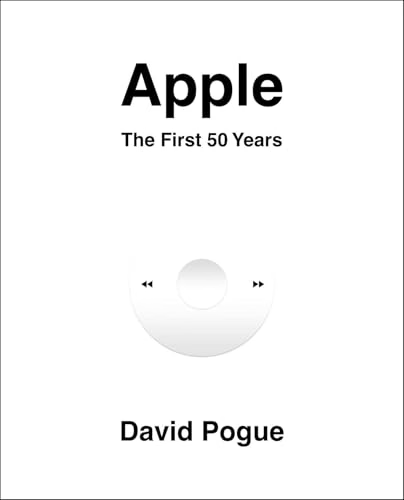
David Pogue's Apple: The First 50 Years is a beautifully assembled visual history that excels at chronicling the company's legendary early decades but stumbles when it reaches the modern era. This isn't a critical deep-dive into Apple's corporate evolution—it's a lovingly curated scrapbook with a tech columnist's irreverent voice narrating the journey. For longtime Apple devotees, it delivers genuine emotional resonance. For readers seeking rigorous business analysis, it offers something closer to an illustrated reference manual.
The book's fundamental tension emerges immediately: Pogue writes like he talks—colloquial, sarcastic, opinionated—which creates an engaging conversational tone but sometimes undercuts the authority expected from a comprehensive corporate history. Think The Innovators meets a witty tech blogger rather than Shoe Dog or Becoming Steve Jobs. That tonal choice works brilliantly for the Steve Jobs era but becomes increasingly problematic as the narrative pushes forward.
What Actually Happens Here
Pogue structures the book chronologically across roughly five decades, beginning with the 1976 garage founding and concluding with contemporary Apple under Tim Cook. The narrative arc follows the familiar beats: Wozniak and Jobs's partnership, the Apple II's revolutionary impact, the Macintosh's creative ambition, Jobs's ouster and exile, the company's near-collapse, his triumphant return, and the iPhone's world-altering debut.
What distinguishes this Apple: The First 50 Years review from countless others is how the book handles the post-Jobs transition. Rather than exploring the philosophical and strategic shifts under Cook's leadership, Pogue's prose devolves into product specifications and feature lists. The Tim Cook era receives coverage, certainly, but lacks the narrative tension and human drama that made the earlier chapters compulsive reading.
The visual presentation deserves specific praise. Inline photographs, sidebars, and design elements transform what could be dry corporate history into something genuinely browsable. Seeing the actual hardware—from the original Macintosh to early iPhone prototypes—alongside the text provides context that words alone cannot convey. This is particularly effective in the 1980s and 1990s sections, where aesthetic innovation was central to Apple's identity.
The Strength: Early Apple's Untold Stories
Pogue's greatest achievement lies in humanizing Apple's origin story. Beyond the mythology, we encounter the practical struggles, emotional conflicts, and near-disasters that preceded iconic product launches. The book reveals how many products never reached consumers, how internal politics shaped design decisions, and how personality clashes drove strategic pivots.
The first-hand quotes from major Apple players—both historical figures and current executives—add credibility and intimacy. Pogue conducted extensive interviews, and this legwork shows. You're not reading secondhand accounts; you're encountering voices directly addressing their roles in Apple's evolution.
For readers who owned early Macs or iPods, this section triggers genuine nostalgia. The book functions as a time capsule, reminding long-time users of technological choices that felt revolutionary at the time. That emotional resonance is real and valuable, even if it's not the same as rigorous analysis.
Where It Falters: Modern Apple and Missing Accountability
The final third represents a significant tonal and analytical shift. With many contemporary figures still employed at Apple, Pogue operates under obvious constraints. Nobody's spilling behind-the-scenes secrets about current leadership. The result? Product timelines and feature specifications replace narrative momentum.
This limitation reveals a larger problem: the book accepts certain narratives without sufficient scrutiny. Pogue occasionally relies on anecdotes and claims that warrant deeper investigation. A more rigorous historian would have pushed back on questionable assertions rather than accepting them at face value. The tech columnist's instinct—to entertain and inform simultaneously—sometimes overrides the historian's obligation to verify and contextualize.
The tonal inconsistency also becomes wearing. Pogue's colloquialisms and sarcastic asides work when describing Jobs's product presentations or the Macintosh's development. They feel jarring when discussing Apple's supply chain practices or market strategy shifts. The voice that charms in early chapters occasionally undermines credibility in later ones.
Comparing to the Competition
Readers familiar with The Innovators by Walter Isaacson will notice the difference immediately. Isaacson's Jobs biography offers psychological depth and critical assessment. Pogue's book prioritizes accessibility and visual appeal over interpretive rigor. Similarly, Shoe Dog by Phil Knight provides interior monologue and philosophical reflection; Apple: The First 50 Years remains observational and external.
That's not necessarily a weakness—different books serve different purposes. But it's important context. If you're seeking a definitive critical analysis of Apple's corporate evolution, this isn't it. If you want an engaging, beautifully illustrated chronicle of Apple's journey with insider perspectives, this delivers exactly that.
Who Should Actually Read This
Perfect for: Long-time Apple users seeking nostalgic reconnection with their technological history. Business students wanting an accessible introduction to tech industry evolution. Apple enthusiasts who own multiple devices and want insider stories about their creation. Audiobook listeners (the narration is genuinely excellent, and audio clips of Jobs and Cook add dimension). Anyone interested in how design and innovation shaped consumer technology.
Will Frustrate: Readers expecting rigorous business analysis or critical examination of Apple's contemporary practices. Historians seeking primary source documentation or footnoted arguments. Those looking for deep psychological profiles of current Apple leadership. Readers who demand accountability journalism regarding labor practices, environmental impact, or market dominance.
The Audiobook Advantage
One reader observation deserves amplification: the audiobook version substantially elevates the experience. Pogue's narration—drawing on his background as a former newsman—brings warmth and humor to the text. The inclusion of audio clips featuring Jobs and Cook during presentations creates an immersive quality that print cannot match. If you're choosing between formats, the audiobook merits serious consideration.
Verdict: A Beautiful Reference, Not a Definitive History
Apple: The First 50 Years succeeds as an illustrated chronicle and fails as critical history. Pogue's conversational tone and visual presentation make it exceptionally readable, particularly for the Jobs era. The interviews and behind-the-scenes details provide genuine value. But the book's constraints—both self-imposed through tone and external through access limitations—prevent it from achieving the depth and accountability that serious corporate history demands.
Is this Apple: The First 50 Years review recommending you buy it? Yes, with caveats. If you're an Apple enthusiast, longtime user, or casual tech history reader, this belongs on your shelf. If you're seeking rigorous business analysis or critical examination of Apple's modern practices, look elsewhere. The book knows exactly what it is: a beautifully crafted, accessible, and emotionally resonant celebration of five decades of innovation. It simply doesn't pretend to be anything more ambitious than that—which is both its greatest strength and its most significant limitation.
Final Score: 7.5/10 — Delivers excellent nostalgia and insider access for Apple enthusiasts, but sacrifices analytical depth for accessibility and struggles with its modern era coverage.