Category:
BiographyAmerican Scoundrel Review: The Blueprint for Political Evil
Prices can sometimes be lower on bigger marketplaces, but this link helps independent bookstores and local reading communities.
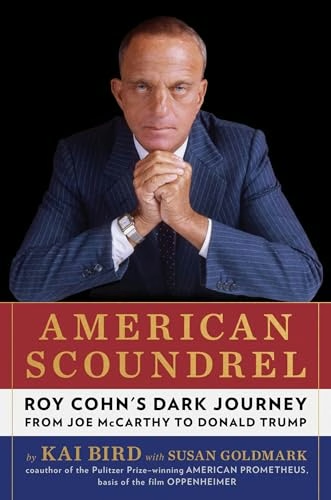
Kai Bird's American Scoundrel: Roy Cohn's Dark Journey from Joe McCarthy to Donald Trump is a masterclass in political biography that transforms a seemingly niche historical figure into a lens for understanding modern American corruption. This isn't just another book about a bad man—it's a forensic examination of how one remorseless operator shaped decades of political culture, from McCarthyism through the Reagan era to Donald Trump's ascent. Bird's 2024 biography delivers what readers are increasingly searching for: a concrete answer to how we got here.
What This Book Actually Delivers
Unlike many political biographies that get bogged down in chronology, Bird structures American Scoundrel around Cohn's evolving roles as a weapon in America's power machinery. You get the young prosecutor who sent Julius and Ethel Rosenberg to execution in their twenties, the Mafia's legal fixer in his thirties, the Studio 54 socialite in his forties, and finally the kingmaker who mentored Donald Trump. Each era reveals not a man changing but a criminal perfecting his craft.
The book's most striking contribution is documenting what previous accounts missed: Cohn's transactional relationship with gossip columnists as a primary tool of influence. He understood before anyone else that controlling narrative through media leaks was more powerful than controlling courtrooms. This detail alone explains his outsized influence across four decades when his technical legal skills were, frankly, mediocre.
The Writing: Gossipy Without Being Tabloid
Bird brings the narrative energy of a true crime writer to serious biography. The prose moves. You want to know what happens next, even though history has already decided the outcome. He balances meticulous research with the kind of scene-setting that makes Cohn's world tangible—the botched childhood surgery that left the infamous scar, the obsessive phone calls from Trump (sometimes a dozen daily), the carefully cultivated friendships with Barbara Walters and Andy Warhol.
The middle section does sag slightly, as some readers noted. When Bird catalogs Cohn's various indictments and acquittals, the repetition of "charged with fraud, acquitted again" can feel like treading water. But this structural choice actually serves a purpose: it hammers home that Cohn wasn't brilliant at evading justice—he was simply protected by a system that refused to hold him accountable.
Where This Book Excels
Bird refuses to psychoanalyze Cohn's closeted sexuality into an excuse. Yes, Cohn maintained what his friend Sidney Zion called "a closet with neon lights," but Bird treats this as character detail, not explanation. Cohn was corrupt because he chose to be corrupt, not because of trauma or insecurity. This moral clarity is rare in contemporary biography.
The Trump connection, which could have felt tacked-on, instead reads as inevitable. Bird demonstrates that Trump didn't invent his approach to business and politics—he inherited it wholesale from Cohn. The lesson Cohn taught his "best friend" was simple: deny everything, attack accusers, and find lawyers willing to break rules. Bird doesn't editorialize about this; he lets the evidence speak.
Most valuably, American Scoundrel fills a genuine gap in American political history. Cohn appears in other books as a supporting character, but he deserves the center stage. He was present at nearly every major corruption scandal from the 1950s onward. Understanding Cohn is understanding how American corruption actually operates—not through ideology but through personal loyalty, transactional favors, and the strategic deployment of information.
What Doesn't Quite Work
The book occasionally struggles with Cohn's early life. Bird tries to construct a psychological profile from his childhood, but it feels obligatory rather than illuminating. Cohn was simply ambitious and amoral from the start—the causal factors are less interesting than what he actually did with those traits.
Some readers will find the density of names and scandals overwhelming. Bird doesn't always pause to explain who minor figures are or why certain cases matter. If you're not already familiar with mid-century New York power structures, you'll occasionally feel lost. This isn't a flaw exactly, but it means American Scoundrel rewards readers who come prepared.
The book also can't fully document Cohn's corruption because, as Bird acknowledges, "no one will ever uncover all of the payoffs, bribes, perjury and grift that Cohn engaged in." This honest limitation is refreshing but leaves the biography feeling necessarily incomplete—though that's a feature of the subject matter, not Bird's research.
Who Should Read This
This book is essential for anyone trying to understand contemporary American politics. If you've wondered how Trump operates or why institutional accountability seems to fail at the highest levels, Cohn's biography provides the answer: because it always has.
It's also crucial reading for political historians, journalists covering corruption, and anyone interested in how American power actually works beneath the rhetoric. Readers who enjoyed biographies like The Splendid and the Vile or His Name Is Barbossa will appreciate Bird's narrative drive combined with serious research.
Who won't love this? Readers seeking redemption arcs or moral complexity will be frustrated. Cohn is presented as what he was: a man who "did whatever it took" without genuine remorse. There's no twist where we learn he was secretly principled. If you want your villains to have understandable motivations, look elsewhere.
The Real Question: Is It Worth Reading?
Yes, absolutely. American Scoundrel is that rare political biography that feels simultaneously like essential history and compulsive reading. Bird has written a book that explains not just who Roy Cohn was, but why his particular brand of ruthlessness became the template for American power-broking. At a moment when understanding institutional corruption feels urgent, this biography does the serious work of showing how it actually happens.
The book's central argument—that Cohn was a "nefarious actor in one unscrupulous tale after another," a true Zelig of the dark side—becomes more relevant with each passing year. Bird doesn't need to make connections explicit; readers will draw their own conclusions about what Cohn's legacy means for contemporary politics.
Final Score
8.5/10 — A meticulously researched, compulsively readable biography that transforms a historical figure into a lens for understanding American corruption across seven decades.