Category:
Book ReviewsA Trade of Blood Review: Bennett's Masterclass in Empire & Obsession
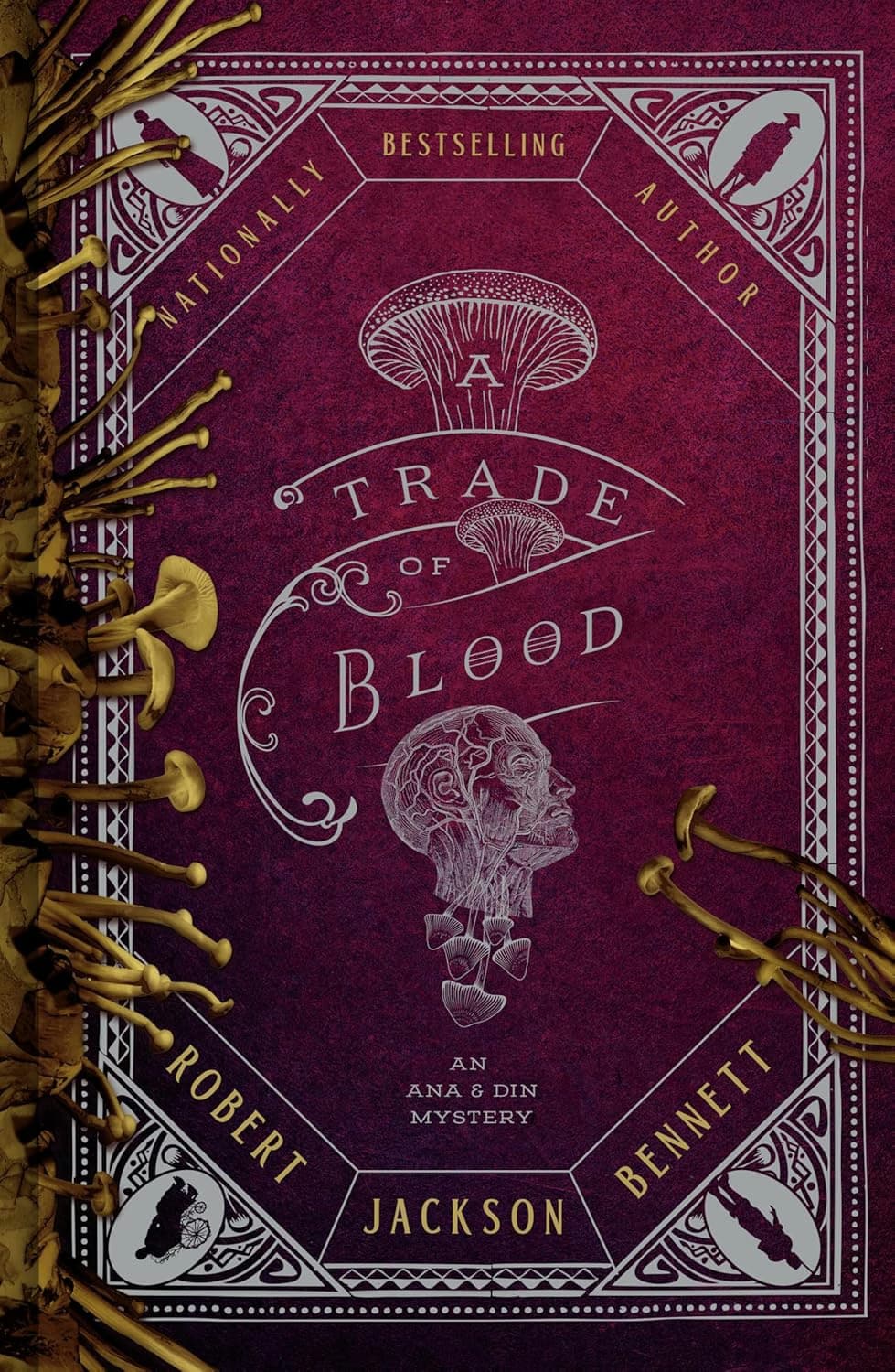
Prices can sometimes be lower on bigger marketplaces, but this link helps independent bookstores and local reading communities.
Robert Jackson Bennett's A Trade of Blood represents a rare achievement in contemporary fantasy: a third book in a series that somehow deepens rather than dilutes what made the originals compelling. This detective mystery doesn't just solve crimes—it interrogates the systems that make crime inevitable, using a locked-room murder as the thread to unravel an entire empire's moral bankruptcy.
The premise appears straightforward: brilliant detective Ana Dolabra and her perpetually exhausted assistant Din must prove a man innocent of a gruesome murder to prevent civil war between two powerful families in the agricultural canton of Sapirdad. But Bennett has never been interested in straightforward narratives. What unfolds is a labyrinthine exploration of hunger—literal and metaphorical—where the real crime isn't the murder at all, but the systems that have normalized atrocity.
What This Book Actually Is
A Trade of Blood functions as three distinct narratives woven together with surgical precision. On the surface, it's a mystery thriller where each clue uncovered brings new deaths, each solution spirals into deeper complications. Underneath, it's a character study of Din Kol grappling with family trauma and his own complicity in systems he's beginning to recognize as monstrous. At its foundation, it's Bennett's most sustained critique of how empires—and by extension, our own systems—commodify life itself.
The setting is crucial. Sapirdad isn't just a backdrop; it's a character defined by its slaughterhouses, bean fields, and the urhosi cattle that sustain the entire Khanum empire. Bennett doesn't describe these spaces with romantic nostalgia. He describes them with the unflinching detail of someone watching how violence becomes routine, how cruelty becomes infrastructure.
The Detective Partnership That Elevates Everything
Ana and Din's dynamic has matured considerably by this third installment. Where earlier books showed them learning to work together, A Trade of Blood presents them as a finely calibrated machine—one where Ana's preternatural pattern recognition meets Din's ground-level investigation skills. More importantly, they trust each other's judgment completely, even when that judgment pulls them toward uncomfortable truths.
Din carries the emotional weight here. His character arc—dealing with family trauma, romantic complications, and the dawning realization that he's been complicit in systems he now finds abhorrent—gives the mystery its genuine stakes. Bennett refuses to make this easy or neat. Din doesn't have revelations that solve his problems; he has moments of clarity that complicate them further.
Ana remains astonishingly weird and brilliant, delivering rants that establish her worldview with the force of manifestos. She's not a genius detective despite her eccentricity; her eccentricity is what allows her to see patterns others miss.
What Works: The Architecture of Atrocity
Bennett's greatest strength in A Trade of Blood is his willingness to let worldbuilding serve thematic purpose. The concentric ring model of the Khanum empire—with the Imperial Sanctum at the center and three rings of territory radiating outward—isn't just clever geography. It's a visual representation of how power concentrates and how exploitation radiates outward from the center.
The murder itself is genuinely impossible in the way that matters: not just logistically puzzling, but philosophically troubling. A locked room, two lovers, one death, and no clear memory of guilt. Bennett uses this impossibility to ask uncomfortable questions about culpability, consciousness, and whether intention matters when systems do the killing for you.
The pacing is relentless without feeling rushed. Each revelation lands with weight because Bennett has earned it through careful construction. The mystery unfolds with the inevitability of a mathematical proof, where each new piece of information doesn't just answer questions but recontextualizes everything that came before.
Where It Stumbles: The Weight of Ambition
The A Trade of Blood review landscape reveals one consistent tension: this book is denser and darker than its predecessors, and that density isn't universally appreciated. Bennett is juggling multiple timelines, biological phenomena that challenge readers' comfort zones, and philosophical questions about empire and exploitation. Sometimes these elements feel like they're straining against the mystery plot's traditional structure.
The biological horror element—present but not dwelled upon—will disturb some readers and feel gratuitous to others. It serves Bennett's thematic purposes (everything circles back to hunger and consumption), but it's deployed in ways that prioritize impact over explanation.
Din's romantic complications, while character-appropriate, occasionally feel like they're pulling focus from the central mystery. Readers seeking a tightly plotted whodunit might find themselves frustrated by sequences that prioritize Din's internal conflict over forward momentum.
Who Should Read This (And Who Shouldn't)
A Trade of Blood is perfect for readers who loved The Tainted Cup and The Mask of Mirrors—those who come to Bennett for his ability to blend mystery, worldbuilding, and moral complexity. If you appreciated how the previous books used detective work as a lens to examine systemic injustice, this is essential reading.
It's also ideal for readers who want their fantasy to ask uncomfortable questions. This isn't escapism; it's interrogation. If you loved works like The Goblin Emperor for their character-driven narratives or The City of Brass for their willingness to complicate empire, you'll find much to admire here.
This book isn't for readers seeking straightforward entertainment. If you want a mystery where the solution feels satisfying because it wraps up neatly, A Trade of Blood will frustrate you. Bennett's solutions complicate more than they resolve. If biological horror elements are a dealbreaker, this book contains moments that will test your tolerance.
The Verdict: A Masterclass in What Series Can Become
Robert Jackson Bennett's A Trade of Blood proves that third books don't have to be exhausted retreads. Instead, it's a deepening—darker, more ambitious, more willing to let its characters sit in moral ambiguity. The mystery is genuinely engaging, the worldbuilding serves thematic purpose rather than mere spectacle, and the character work rivals anything Bennett has written.
Is A Trade of Blood worth reading? Absolutely—if you're willing to meet Bennett's ambition halfway. This isn't comfort reading; it's the kind of book that rewires how you think about detective fiction and what fantasy can interrogate about power, consumption, and complicity.
Compared to other contemporary fantasy mysteries like The Mask of Mirrors or even The Goblin Emperor, A Trade of Blood sits firmly in the camp of intelligent, unsettling fiction that refuses easy answers. It's the work of a writer at the height of his powers, uninterested in repeating himself and committed to using genre conventions to ask genuinely difficult questions.
Final Score: 9/10 — A stunning achievement in mystery and character work that uses an impossible murder to examine how empires normalize atrocity.