Category:
Book ReviewsA Gracious Enemy & After the War Volume Two Review
Prices can sometimes be lower on bigger marketplaces, but this link helps independent bookstores and local reading communities.
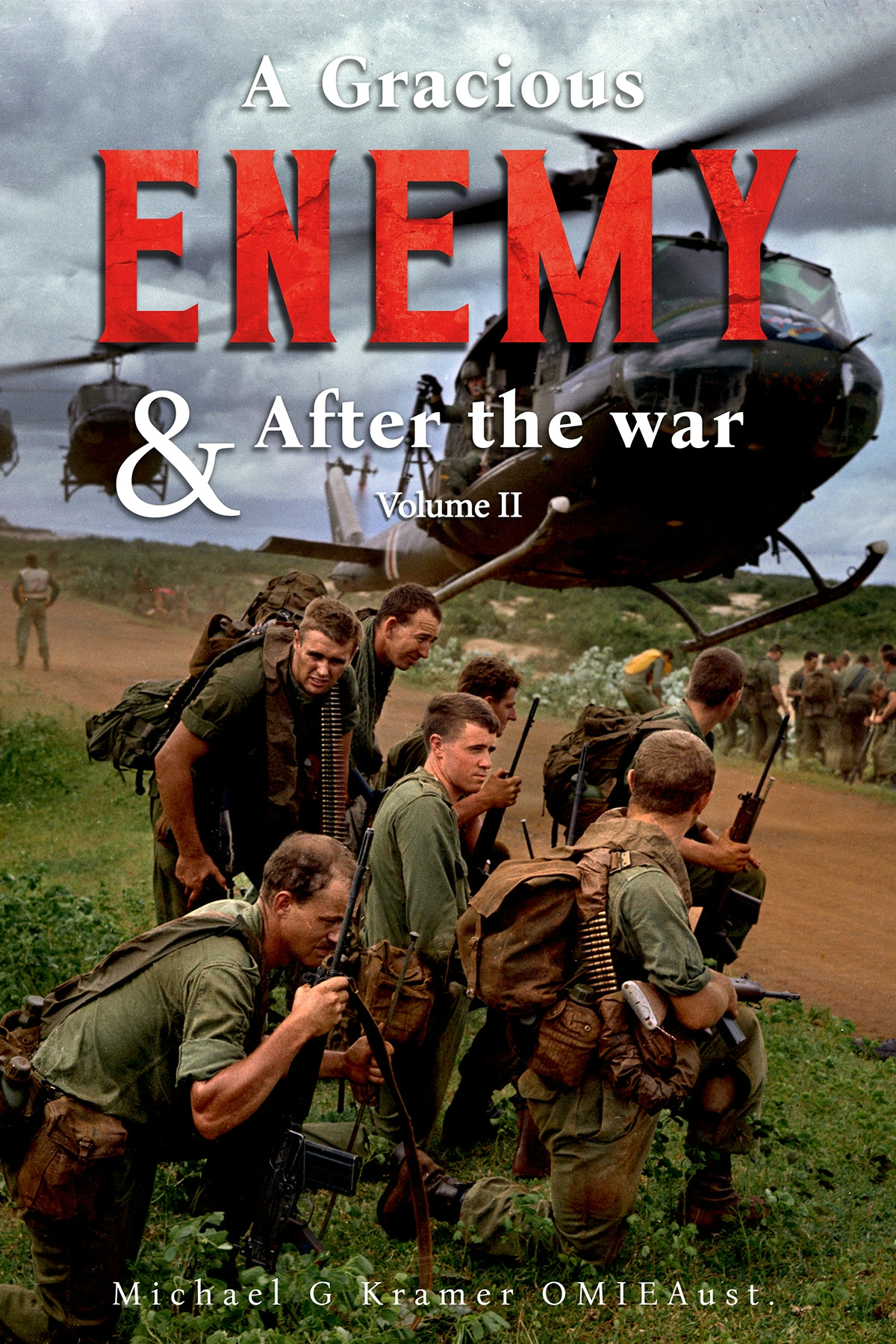
Michael G. Kramer's A Gracious Enemy & After the War Volume Two is a historically grounded work that ventures into territory most Vietnam War narratives deliberately avoid—the untold aftermath and the geopolitical near-misses that could have escalated the conflict into nuclear catastrophe. This isn't a conventional war memoir or straightforward history; it's a hybrid that blends meticulous research with human storytelling, creating something that feels both urgent and reflective.
The book's most shocking revelation arrives early: during the 1953-1954 siege at Dien Bien Phu, the U.S. seriously contemplated Operation Vulture, a military intervention that would have deployed nuclear weapons against Viet Minh positions. Only British reluctance and General Matthew Ridgeway's opposition prevented what could have been a catastrophic escalation. This isn't sensationalism—it's documented history that deserves far more attention than it receives in mainstream discussions of the Vietnam War. Kramer presents this with appropriate gravity, neither exploiting the horror nor minimizing its implications.
What This Book Actually Covers
Unlike Volume One, this sequel deliberately focuses on material Kramer excluded from his first installment. The narrative arc spans from the desperate final days of French colonial rule through Vietnam's invasion of Cambodia and the Pol Pot regime's collapse into the jungle. Kramer doesn't shy away from examining the Tiger Cages—the brutal prison system used to torture political prisoners—or the Third Indochina War's devastating human costs.
What distinguishes this work is its inclusion of an interview with Hun Sen, Cambodia's longtime leader. Rather than offering a sanitized political perspective, this conversation provides contextual understanding of the regional chaos that Western audiences rarely encounter. The book positions the Vietnamese "Boat People"—refugees who fled communist Vietnam—as central characters rather than footnotes, exploring how thousands of displaced individuals eventually rebuilt their lives, primarily in Australia.
The Writing: Accessible Without Oversimplifying
Kramer, an architect and engineer by training and a Vietnam War veteran who served with the First Battalion Royal Australian Regiment (1RAR) in 1968-1969, writes with the precision of someone trained in technical fields but the empathy of someone who lived through the conflict. His sentences are clear and direct; he avoids the purple prose that often bogs down historical fiction.
The multilingual elements—translated passages from Vietnamese and other languages—occasionally disrupt reading flow, but they serve a purpose: authenticity. These aren't sanitized English-language retellings but actual voices from the period. Readers accustomed to seamless, polished narratives may find this jarring. Others will recognize it as honest.
The pacing occasionally stutters. Kramer moves between macro-historical analysis (Operation Vulture, geopolitical calculations) and intimate personal narratives (individual refugee stories, family separations). This tonal shift works more often than it doesn't, but some readers will find the transitions abrupt.
What Works Exceptionally Well
The refugee narratives are the book's strongest element. Kramer traces the Vietnamese diaspora with genuine care, documenting how people who arrived in Australia facing "blatant hostility" became vibrant contributors to their adopted society. Many became successful entrepreneurs and business operators, traveling freely between Australia and Vietnam decades later—a quiet triumph that deserves telling.
The historical research is thorough and evident on every page. Kramer doesn't make claims without foundation, and his willingness to present uncomfortable truths—American interventionism, French colonial brutality, Soviet and Chinese proxy involvement—demonstrates intellectual honesty. This isn't propaganda disguised as history; it's a serious attempt to understand a complex conflict through multiple lenses.
The book also succeeds in making abstract geopolitical decisions feel personal. When you read about Operation Vulture alongside the story of a Vietnamese family's escape, the stakes become visceral rather than theoretical.
Where It Stumbles
The scope is simultaneously the book's strength and weakness. By attempting to cover Operation Vulture, the Tiger Cages, the Cambodia invasion, and refugee resettlement, Kramer occasionally sacrifices depth for breadth. Some sections feel rushed, as though entire chapters could have been expanded into their own volumes.
The book's subtitle—"After the War"—is somewhat misleading. While the aftermath matters significantly, roughly a third of the content deals with wartime events and decisions. Readers expecting exclusively post-1975 material may feel the focus is broader than advertised.
There's also an occasional didacticism that creeps in. Kramer clearly believes readers should reach particular conclusions about American foreign policy, and while his perspective is defensible, the book sometimes tips into advocacy rather than inquiry. The best historical works invite readers to draw their own conclusions; this one occasionally guides too firmly.
Who Should Read This (And Who Shouldn't)
This book is essential for anyone seriously studying the Vietnam War, the Indochina conflicts, or Cold War geopolitics. It fills genuine gaps in English-language historical discourse, particularly regarding Operation Vulture and the refugee experience in Australia.
Historical fiction enthusiasts will appreciate Kramer's approach—he treats history with respect while maintaining narrative momentum. Readers interested in immigration, cultural integration, and diaspora studies will find substantive material here.
Skip this if you want conventional war heroics or straightforward chronological narrative. Skip it if you're uncomfortable with morally ambiguous portrayals of American foreign policy. Skip it if you prefer your history entirely detached and academic; Kramer's personal connection to the material means his perspective is visible throughout.
The Verdict on Whether It's Worth Reading
A Gracious Enemy & After the War Volume Two is absolutely worth reading, particularly for readers willing to engage with challenging historical material. It's not perfect—the scope sometimes overwhelms focus, and the tonal shifts can feel uneven. But it accomplishes something rare: it makes forgotten history feel urgent and present without exploiting tragedy for effect.
The book's greatest achievement is humanizing abstractions. Operation Vulture becomes not just a historical curiosity but a near-catastrophe with implications we're still living with. The Boat People become individuals with names, ambitions, and resilience rather than statistics. This is what serious historical writing should do.
Compare this to works like Tim O'Brien's The Things They Carried (which prioritizes emotional truth over historical accuracy) or Neil Sheehan's A Bright Shining Lie (which prioritizes political critique over narrative accessibility). Kramer's book occupies a middle ground—it's more historically rigorous than O'Brien while more narratively engaging than traditional military history. It won't satisfy everyone, but it will genuinely educate anyone willing to spend time with it.
Kramer's previous eight novels demonstrate his commitment to bringing historical understanding to contemporary audiences. With this volume, he's added significantly to our collective understanding of the Vietnam War's true costs and the resilience of those displaced by it.