Category:
Book ReviewsA Bigger Life Review: Louise O'Neill's Honest Reckoning
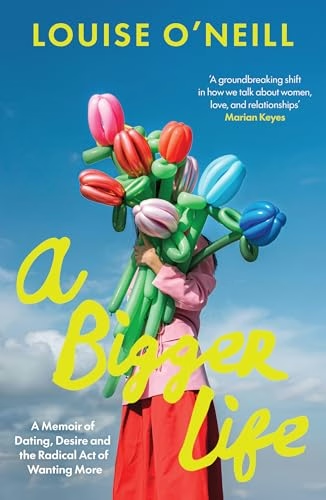
Prices can sometimes be lower on bigger marketplaces, but this link helps independent bookstores and local reading communities.
Quick Verdict
A Bigger Life by Louise O'Neill is a refreshingly candid memoir that transcends the tired "woman finds herself through dating" trope by coupling brutally honest self-examination with sharp cultural criticism. This isn't a feel-good dating romp—it's a manifesto wrapped in personal narrative, and it's absolutely worth reading if you're prepared for uncomfortable truths about modern womanhood, desire, and the stories we've internalized about what we're supposed to want.
What This Book Actually Is
At its core, Louise O'Neill's A Bigger Life documents what happened when a 38-year-old woman's long-term relationship collapsed, leaving her unmoored and facing a terrifying blank canvas. Rather than retreating into self-help clichés or wine-soaked commiseration, O'Neill made a radical decision: say yes to everything, take risks, and reclaim her life on her own terms. What follows is a dating experiment spanning Paris, London, New York, and beyond—but the real story isn't about finding "the one." It's about deconstructing the mythology we've absorbed about what women should want, who we should become, and what constitutes a life well-lived.
The memoir oscillates between specific dating encounters and deeper philosophical interrogation. O'Neill doesn't just tell you what happened; she interrogates why it happened, what it reveals about her conditioning, and what it exposes about the systems designed to keep women small.
The Writing: Brutal Honesty as Literary Device
O'Neill's prose style here mirrors her previous fiction work—unflinching, witty, and willing to sit in discomfort. She writes about eating disorders, body image anxiety, cosmetic procedures, and sexual assault with the same unflinching gaze she turns on dating apps and desire. There's no self-protective narrative arc here, no convenient redemption that lets the reader off the hook.
What makes this memoir distinctive is that O'Neill refuses the false consciousness of the unreliable narrator who ultimately learns she was wrong all along. Instead, she holds contradictions: she gets filler while criticizing beauty standards, she pursues casual sex while acknowledging how patriarchy has shaped her sexuality, she seeks validation from men while understanding the trap of that seeking. This isn't weakness in the writing—it's the point.
The audiobook version, in particular, gains power from O'Neill's own narration. Her Irish accent and cadence create an intimate conversational quality, as if she's sitting across from you with a glass of wine, about to tell you something uncomfortable.
What Actually Works
The cultural criticism embedded in the personal narrative. O'Neill doesn't separate her individual experience from systemic analysis. She connects her dating struggles to broader conversations about aging women, fertility pressure, cosmetic culture, and the commodification of female bodies. This prevents the memoir from collapsing into solipsism.
The refusal of conventional memoir structure. You won't find the neat three-act structure where the protagonist learns her lesson and emerges transformed. Instead, O'Neill shows recursive patterns, contradictions, and ongoing confusion—which is far more honest about how actual recovery works.
The specificity of the dating encounters. Rather than generic "he was tall and boring," O'Neill renders particular conversations, moments of connection, and instances of profound disconnection with enough detail that you understand what she's actually grappling with. Some encounters are tender, some are absurd, some are genuinely disturbing—and the range matters.
The interrogation of desire itself. This memoir asks hard questions about whether what we want is actually what we want, or what we've been conditioned to want. That's more intellectually rigorous than most memoirs in this space.
Where It Stumbles
The memoir's length occasionally works against it. At certain points, the accumulation of dating stories risks becoming repetitive—not because they're similar, but because the underlying pattern of seeking validation from unavailable men becomes predictable. Some readers will find this repetition mirrors the actual experience of dating apps; others will find it drags.
There's also a tension between the memoir's accessibility and its intellectual ambition. O'Neill is writing for a general audience, but the cultural analysis sometimes feels underexplored—you want her to push further into certain observations about consumption, capitalism, and female desire, but she pulls back into the personal narrative instead.
Finally, the resolution (or lack thereof) might frustrate readers seeking catharsis. If you're looking for the moment where Louise figures it all out, you won't find it. That's intentional, but it's not for everyone.
The Comparison Point
If you've read Crying in H Mart by Michelle Zauner or The Year of Magical Thinking by Joan Didion, you understand memoirs that refuse neat conclusions. A Bigger Life sits in that tradition—personal narrative as cultural document. It's less similar to the confessional dating memoirs that have saturated the market in recent years, and far more aligned with memoirs that use individual experience as a lens for systemic critique.
Who Should (and Shouldn't) Read This
Perfect for: Women navigating midlife transitions, anyone interested in cultural criticism wrapped in narrative, readers who appreciate O'Neill's previous work, people questioning what they've been taught to want, those ready to sit with uncomfortable truths about desire and conditioning.
Skip it if: You're looking for a straightforward dating success story, you need clear resolutions and character arcs, you prefer memoirs that feel therapeutic and affirming, or you want to avoid extended reflection on beauty standards and body image.
The honest take: This book will resonate most powerfully with women who've internalized the message that their worth is tied to romantic partnership and who are ready to interrogate that conditioning. It's not a book for everyone, but it's a book for the right person.
Why Louise O'Neill's Memoir Matters Now
The timing of A Bigger Life feels significant. We're in a cultural moment where women are increasingly questioning the narratives they've inherited—about marriage, motherhood, body image, and desire. O'Neill's memoir arrives as both validation for those already asking hard questions and provocation for those still operating within the old frameworks.
She's also writing from a distinctly Irish perspective, which brings a particular cultural texture to conversations about Catholicism, shame, and female sexuality that feels fresher than the American confessional memoir model.
The Real Question: Is It Worth Reading?
Yes—with the caveat that "worth reading" depends on what you're seeking. If you want entertainment, there are easier options. If you want a book that will make you think differently about your own conditioning, your desires, and what you actually want from life, this delivers.
The A Bigger Life review consensus across readers reflects genuine appreciation for O'Neill's willingness to go unflinching into uncomfortable territory. Even readers who didn't love every page respect the book's refusal to provide false comfort.
Final Verdict
8/10 — A Bigger Life is a memoir that trusts its readers to sit with complexity, contradiction, and the messy reality of becoming yourself.
Key Takeaways
- This isn't a dating book dressed up as memoir; it's a cultural critique dressed up as personal narrative
- O'Neill's willingness to hold contradictions (wanting things she intellectually questions) is the book's greatest strength
- The writing is sharp, specific, and refuses easy conclusions
- It works best for readers ready to interrogate their own conditioning
- The memoir's power lies in its refusal to provide false catharsis or neat resolution
If you're considering picking up A Bigger Life, go in expecting to have your assumptions challenged rather than confirmed. That's where the real value lives.