Category:
Book ReviewsГемінґвей нічого не знає: War Prose That Shatters Illusions
Prices can sometimes be lower on bigger marketplaces, but this link helps independent bookstores and local reading communities.
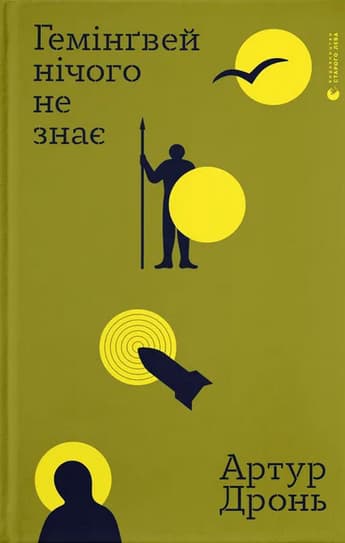
Artur Dron's debut collection Гемінґвей нічого не знає (Hemingway Knows Nothing) is a devastating and luminous work of war testimony that fundamentally challenges how Western literature has represented combat. This is not a book that asks permission to move you—it demands your attention, your tears, and your reckoning with a conflict that existing literary frameworks cannot contain. With an extraordinary 4.8/5 rating from nearly 3,700 readers, this collection stands as perhaps the most visceral military text to emerge from Ukraine's full-scale war.
The Central Provocation: Why Hemingway Failed
The title itself is a manifesto. Dron, who named his rifle after Ernest Hemingway and once revered the author's sparse, masculine prose, discovered at age 21 that the literary giant had nothing useful to say about this war. Hemingway wrote about conflict as an outsider choosing adventure; Dron writes as a young man forced to defend his nation's existence. The irony cuts deeper than mere literary critique—it's a statement that previous generations' war literature, no matter how celebrated, cannot translate the specific horror of existential national conflict.
This provocation works because it's earned through lived experience, not theoretical posturing. Readers consistently note that Dron's authority comes from shrapnel wounds, from counting incoming mortar strikes, from holding cooling bodies of fallen brothers-in-arms. He doesn't theorize about trauma; he bleeds it onto the page.
What This Collection Actually Is
Гемінґвей нічого не знає is a hybrid work—part essay, part testimony, part spiritual reckoning. It's structured as interconnected short prose pieces that move between battlefield observation, philosophical reflection, and intimate portraiture of individual soldiers. The collection explores faith tested by fire, brotherhood forged in trenches, the paradox of love persisting amid industrial death, and the specifically Ukrainian cultural resistance that sustains soldiers when traditional anti-war literature offers only despair.
The book's power lies in its refusal to separate the metaphysical from the material. Dron writes of "God in the Trenches" not as metaphor but as lived theological experience. He captures the moment when a soldier transitions from civilian consciousness to someone who has looked directly at mortality and continued breathing.
The Writing: Precision Meets Rawness
Dron's prose style is deceptively simple—short sentences, concrete images, minimal ornamentation. This restraint is not Hemingway's cool detachment but rather the speech pattern of someone who has survived something that cannot be decorated with language. When he describes examining the still-warm body of a fallen comrade for "signs of life (but in vain, in vain...)", the repetition and ellipsis do more work than any elaborate metaphor could.
Readers note that this stylistic choice creates an almost cinematic effect, as if watching montage sequences in a war film—a technique rarely executed successfully in literary prose. The collection moves between intimate moments (soldiers discussing Parisian poverty in Hemingway's biography during a lull in shelling) and apocalyptic scale (the Eastern Front as a landscape where all previous literary categories collapse).
The Ukrainian language itself becomes a character—a cultural anchor that survives when imported literary traditions fail. Dron's references to Ukrainian culture in a soldier's backpack, to folk traditions, to the specificity of Zaporizhzhia region geography, root the text in particular place and identity rather than universal abstractions.
What Elevates This Beyond Typical War Memoir
The collection's most distinctive achievement is its refusal of both nihilism and propaganda. Dron doesn't present soldiers as heroes or victims, but as ordinary young people navigating extraordinary circumstances. He writes with unflinching honesty about fear, about the absurdity of military bureaucracy, about moments of unexpected tenderness amid horror.
Several readers describe experiencing catharsis—that Aristotelian release of emotion through witnessing suffering presented with artistic integrity. One reader who had abandoned other war books as unbearable found themselves unable to stop reading this one, despite (or because of) its emotional intensity. Another notes that the collection is "the only book about war I could finish," suggesting that Dron has achieved something most war writers attempt but fail to execute: emotional truth without emotional manipulation.
The spiritual dimension is particularly striking. Rather than dismissing faith as naive or exploiting it for sentimentality, Dron explores how belief functions as survival mechanism and genuine philosophical anchor. This will resonate powerfully with readers seeking existential meaning in literature, and will likely alienate readers hostile to religious themes—but Dron's treatment is too honest to dismiss as preachy.
Structural Brilliance and Potential Friction Points
The collection's interconnected structure means individual pieces gain resonance through accumulated context. This creates powerful cumulative emotional impact but may frustrate readers seeking standalone narratives. Some pieces are short—almost fragment-like—which some will experience as poetic compression and others as incompleteness.
The density of specific Ukrainian references and military terminology might require some readers to engage more actively with context. This isn't a weakness—it's the text refusing to simplify itself for comfort—but it's worth noting for readers seeking more accessible war literature.
Who This Book Is Perfect For
This collection is essential reading for anyone seeking to understand contemporary Ukrainian experience, for readers interested in how war transforms literary consciousness, for those wanting authentic military testimony rather than mediated accounts, and for anyone ready to be genuinely moved by prose that doesn't ask permission to devastate.
It's also crucial for Western readers and writers, particularly those who imagine they understand modern conflict through inherited literary frameworks. Dron's title directly addresses this audience: you know nothing until you read this.
Who Might Struggle With It
Readers seeking escapism should look elsewhere. Those uncomfortable with religious themes, graphic descriptions of combat trauma, or emotionally demanding prose will find barriers here. Readers preferring traditional narrative structure with clear plot progression may find the essayistic, fragmented approach frustrating. This isn't a book for passive consumption.
The Broader Context
Since Ukraine's 2022 full-scale invasion, dozens of war memoirs and testimonies have emerged. Most document experience; few achieve the artistic integration of form and content that Dron manages. The collection sits alongside works like 1+1 by Ukrainian authors documenting this specific conflict, but distinguishes itself through literary sophistication and philosophical depth.
The book's reception—nearly universal five-star ratings with substantive, detailed responses—suggests readers recognize they're encountering something rare: testimony that functions simultaneously as literature, spiritual document, and political statement without sacrificing authenticity to any single agenda.
Final Verdict
Гемінґвей нічого не знає is not just a significant Ukrainian literary work; it's an essential text for understanding 21st-century warfare, faith, and the limits of inherited cultural frameworks. Whether you're a serious reader of war literature, someone seeking to understand Ukraine beyond headlines, or a person ready to be transformed by prose written in blood and conviction, this collection demands your attention.
Is Гемінґвей нічого не знає worth reading? Absolutely—and you'll finish it changed.